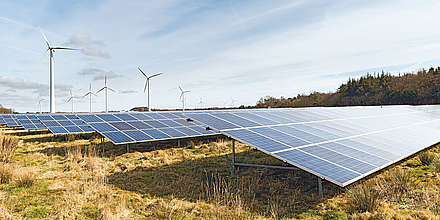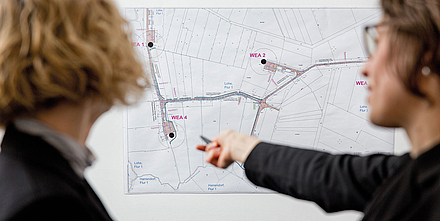
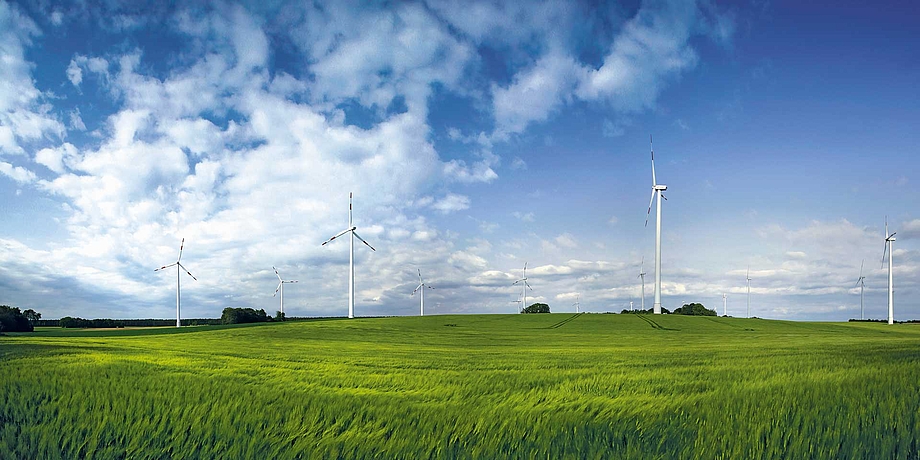
This segment includes power generation at the Group’s own wind and solar parks. The expansion of the portfolio of Group-owned wind and solar parks is a core component of the company’s organic growth model. With the income from the operation of its own wind and solar parks, the company essentially covers all costs in the project development segment, as well as all ongoing corporate costs. The result is a high degree of financial stability and security.
The transfer of completed projects to the company’s own portfolio is based on production costs. The developer or projecting margin, which is realised when projects are sold, is not taken into account. Hidden reserves are created upon taking over projects. If needed, these assets could be sold, with the financial resources tied up in them, plus the aforementioned margins, potentially being released. The hidden reserves held in the company’s own portfolio therefore form an additional, essential basis for the financial stability and long-term solvency of the company. In addition, there is the possibility of upgrading the company’s own wind parks, for example through repowering or efficiency-enhancing measures, and of benefiting from price increases for wind and solar parks on the market.
The Energiekontor Group added the first wind park to its own portfolio in 2002. Since then, the portfolio has been continuously expanded, mainly by adding internally developed projects to the company’s own portfolio. Around half of all projects developed by Energiekontor each year are transferred to the company’s own portfolio. In the past, potentially profitable operational wind parks were also acquired. The projects in question were developed and sold by Energiekontor itself in earlier years, or were from other developers and operators. The company also examines opportunities that could arise from the sale of individual projects and reserves the right to sell individual projects. However, the overall aim is still to continue expanding the company’s own portfolio of wind and solar parks.
At the end of the reporting period, Energiekontor’s own portfolio was dominated by wind parks. The ratio between wind and solar parks is to be balanced out in the years ahead, with an increase in both the regional and technical diversification of the company’s own portfolio. Doing so will contribute to significantly more predictable and continuous income in the medium to long term, as it allows fluctuations in wind and solar radiation to be balanced out. Furthermore, the meteorological power generation curve of both technologies complements each other.
The total nominal power of the wind and solar parks operated by Energiekontor in Germany, the United Kingdom and Portugal amounted to roughly 448 megawatts at the end of the 2025 financial year (31 December 2024: roughly 395 megawatts).
Park | Capacity (MW) |
Alfstedt | 26.5 |
Altlüdersdorf | 13.5 |
Balje-Hörne II | 3.9 |
Beckum III | 1.3 |
Breitendeich | 6.0 |
Briest | 7.5 |
Briest II | 1.5 |
Debstedt | 3.0 |
Engelrod | 5.2 |
Flögeln | 9.2 |
Geldern. | 3.0 |
Halde Nierchen I | 5.0 |
Halde Nierchen II | 4.0 |
Hanstedt-Wriedel | 16.5 |
Hanstedt-Wriedel extension | 31.8 |
Jacobsdorf | 18.0 |
Kajedeich | 4.1 |
Krempel | 14.3 |
Krempel II | 6.5 |
Kreuzau-Steinkaul | 5.5 |
Lengers | 4.5 |
Mauritz (Energiekontor holds 89%) | 4.5 |
Nordleda (Energiekontor holds 51%) | 6.0 |
Oerel (I+II) | 22.8 |
Oerel COWP | 5.7 |
Oederquart Repowering | 16.7 |
Prenzlau | 1.5 |
Thüle | 14.0 |
Wegberg Repowering | 11.2 |
Wind parks in Germany | 259.5 |
|
|
Garzau-Garzin (I und II) | 14.7 |
Königsfeld | 4.6 |
Letschin | 60.0 |
Seukendorf | 11.6 |
Solar parks in Germany | 90.9 |
|
|
Hyndburn | 24.6 |
New Rides | 8.8 |
Withernwick | 26.7 |
Wind parks in the United Kingdom | 60.1 |
|
|
Mafomedes | 4.2 |
Marão | 10.4 |
Montemuro | 10.4 |
Penedo Ruivo | 13.0 |
Wind parks in Portugal | 38.0 |
|
|
Total | 448.4 |